

About the Author
Bill Rogers is a third-generation farmer, United States Air Force veteran meteorologist who works daily with people, like farmers, who live and die by weather decisions. Bill grew up on a farm where timing mattered — seed in the hopper, hay on the ground, livestock exposed — and where “chance of rain” was never good enough.
That need for an accurate forecast was sharpened during a distinguished Air Force career, where Bill served in forecasting roles where accuracy wasn’t optional:
• Army-1 Presidential Helicopter Support
• Space Launch Meteorologist at Vandenberg Air Force Base, supporting roughly twenty launches for every one launch at Cape Kennedy
• Atmospheric Forecaster at NORAD, deep inside Cheyenne Mountain, supporting Top Secret and clandestine operations
• Chief Aviation Meteorologist at Dyess Air Force Base, briefing Strategic Air Command (SAC) and Military Airlift Command (MAC) pilots and crews
Today, at White’s Farm Supply, Bill works side-by-side with farmers across the region. Those conversations take place in the fields and the service departments and parts counters at White's Farm Supply. These chats have revealed a growing problem: farmers feel like forecasts have gotten worse, not because the science failed, but because accountability disappeared.
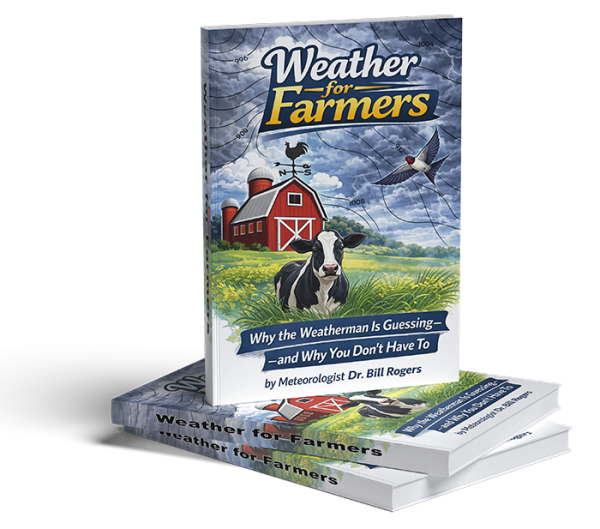
My goal is not to turn every farmer into a meteorologist, but using a simple 10–15 minute daily process, will allow you to understand the weather affecting your farm a whole lot better than the guy on TV reading a script.
You don’t need a degree in meteorology. You just need to stop outsourcing your own judgment. This book aims to help you do that.
